Most people think Jiu Jitsu progress is about techniques. It isn’t.
Progress is about the operating system running underneath your training – the invisible architecture that decides how you train when things are hard, what you prioritize under pressure, and whether your development compounds or collapses over time.
If your operating system is weak, inconsistent, or undefined, your Jiu Jitsu will feel the same. You’ll train a lot. You’ll learn plenty, but very little will hold up – maybe, if you’re lucky, you will become “the white belt that never quit” – *Yawn*.
The Architecture Beneath Technique
Your operating system isn’t your favorite guard or submission. It’s the set of standards, filters, and decision rules that quietly shape every session. It answers the questions most practitioners never think to ask:
- What does a good round look like for me?
- What behaviors are unacceptable, even when I’m tired or frustrated?
- What am I training for in this phase of my development?
Without answers to these questions, your Jiu Jitsu defaults to emotion, ego, intensity, comparison, and whatever the room rewards that day – that’s not development. That’s drift.
When progress slows, people usually blame the wrong things. They say they need more motivation, harder training, better techniques. In reality, they need clarity. Without a defined operating system, intensity replaces intention, rounds replace skill-building, and winning replaces learning. This creates a kind of “training dissonance” – you’re working hard, but it doesn’t feel right.
That friction eventually becomes frustration, inconsistency, burnout, or injury, not because Jiu Jitsu is too hard, but because your training isn’t aligned – you have no internal guide.
The Three Components of a Functional System
A strong Jiu Jitsu operating system has three parts, and each one serves a distinct purpose in keeping your training coherent.
#1 Your Target or “where you’re going”.
This is not a vague goal like “get better” or “be competitive.” It’s a clear picture of what you are building. “I’m building a game that works under fatigue.” “I want calm, positional control before submission.” “I’m developing Jiu Jitsu I can still train at 50.”
If you can’t see it, you can’t steer toward it.
#2 Your Boundaries or “what you refuse to become”.
This is where most clarity actually comes from. Ask yourself: What does bad Jiu Jitsu look like for me? What behaviors do I not want to repeat? What version of myself am I actively avoiding?
Scrambling without control. Winning rounds but injuring partners. Training hard but retaining nothing. Letting ego dictate intensity. Your anti-vision creates boundaries, and boundaries create consistency.
#3 Your Standards or “how you decide in the moment”.
Standards are values made operational.
Not abstract words like discipline, humility, consistency – but phrases you can score yourself against after training. “Protect my partner before protecting my ego.” “Solve the position before escalating intensity.” “Control first. Speed later.” “If I’m confused, I slow down.” “Manage the threat, remove the control.” or “Safety first, escape second.”
If you can’t rate yourself on it after training, it’s not a standard. It’s decoration.
Evolution Through the Belts
Your operating system should evolve as you do – what serves you as a white belt will limit you as a purple belt and it is understanding this prevents stagnation.
At white belt, your goal is to reduce chaos. One position at a time. One problem at a time. Safety and learning over winning – here, your operating system prevents overwhelm. At blue belt, the goal shifts to stopping the drift and enforcing your boundaries. You need defined focus per phase, controlled intensity, and fewer techniques executed better. Your operating system prevents inconsistency.
Purple belt is where you build a system. You develop a clear A-game, structured reactions, and precise questions. Your operating system turns knowledge into reliability. At brown belt, you refine under pressure. Efficiency over effort. Timing over force. Decision quality matters more than volume. Your operating system protects longevity.
By black belt, your operating system becomes leadership. Your behavior is instruction. Your calm becomes contagious. Culture matters as much as technique. Your are a custodian of not only your belt and its reference to others but you push the idea of team-ship.
You’re no longer just training yourself – you’re modeling standards for everyone watching.
What Holds Up
Jiu Jitsu that holds up isn’t flashy. It’s calm. It’s repeatable. It works on bad days, not just good ones; and it only comes from an operating system that prioritises standards over outcomes, decisions over reactions, and alignment over motivation.
Motivation fades. Systems endure.
Most practitioners never install an operating system. They train for years without one, wondering why their progress feels inconsistent, why their best Jiu Jitsu only shows up occasionally, why the gap between their potential and their performance never closes.
The answer isn’t more mat time. It’s more clarity. Define your vision. Define what you refuse to become. Define the standards you can measure yourself against daily, that’s the work that actually compounds – that’s what makes some Jiu Jitsu hold up.
Let’s frame this another way.
Distilling the concept of a Jiu Jitsu OS.
Without an overarching operating system to support your Jiu Jitsu, techniques become simply, isolated “apps” – opened, closed, customised, but never fully integrated.
They will sit on your interface, but without the system beneath them, they can’t perform their intended function, always glitchy and crumble under pressure, so much so that you’ll be afraid to ever pressure-test those “apps”.
Your operating system governs how you train, how you decide under pressure, and what you value on the mat. It determines what actually counts as progress, what you pursue, what you avoid – and why some practitioners move forward while others stay busy.
Jiu Jitsu that holds up isn’t built by collecting more “apps”, it’s built by installing an operating system that can support them with infrastructure and robust a support system when you need it.
Below is some guidance on how to install your operating system (OS), something I wish I’d had thought about earlier into my Jiu Jitsu.
Installing Your Jiu Jitsu Operating System – Your Belt-by-Belt Companion
Every belt level requires a different operating system. The mistake most practitioners make is trying to run the same mental framework at every stage – which leads to frustration, stalled progress, or unnecessary wear and tear. This guide shows you what your operating system should prioritise at each belt, so your Jiu Jitsu continues to hold up as you progress.
White Belt OS: Reduce Chaos

At white belt, the job is not to win rounds, the job is to survive long enough to learn.
Your operating system exists to calm the noise.
Primary Focus
- Safety
- Orientation
- Understanding positions before techniques
Standards to Install
- “Slow is acceptable. Unsafe is not.”
- “If I’m lost, I frame and breathe.”
- “Protect my partner before protecting my ego.”
What Success Looks Like
- You recognise where you are, even if you can’t escape yet
- You tap early and often
- You leave sessions intact and curious, not defeated
Boundaries
- Scrambling without control
- Treating every round like a competition
- Measuring progress by taps alone
Blue Belt OS: Prevent Drift
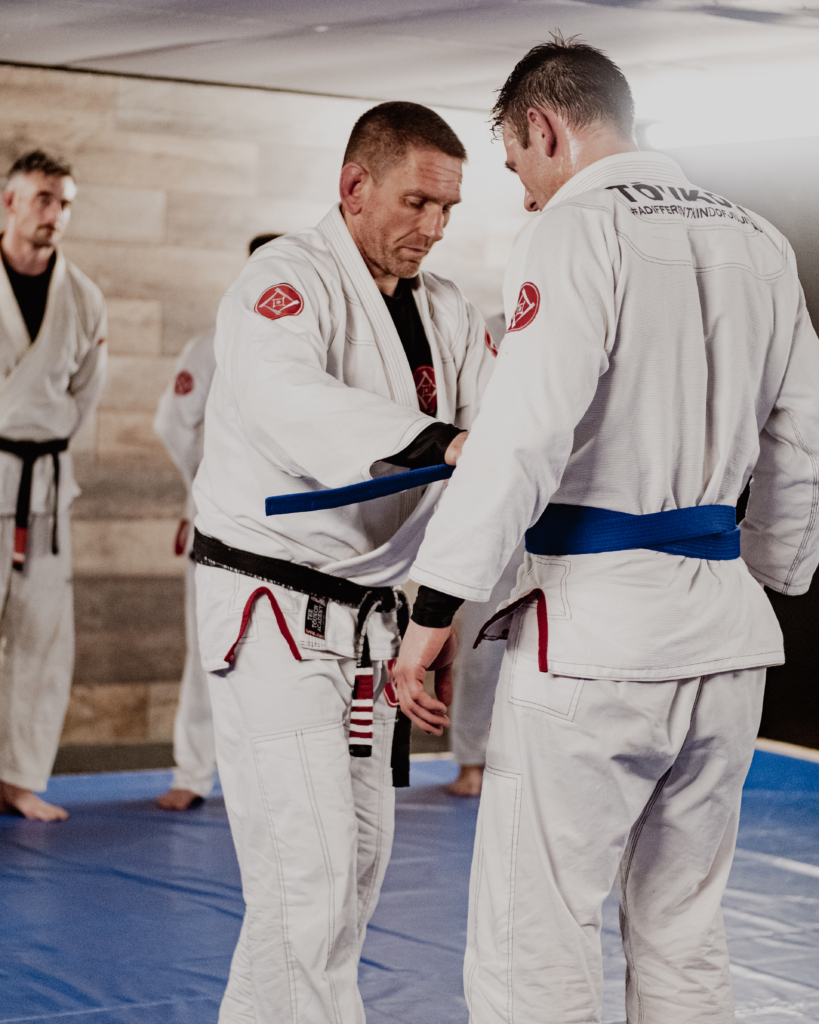
Blue belt is where people quit – not because Jiu Jitsu is hard, but because direction disappears. You now know enough to be dangerous, but not enough to be reliable.
Your operating system exists to stop you wandering.
Primary Focus
- Consistency
- Pattern recognition
- Narrowing your attention
Standards to Install
- “Train fewer positions, more deeply.”
- “Intensity follows clarity – not the other way around.”
- “I leave sessions knowing what I’m working on.”
What Success Looks Like
- You can describe your game, even if it’s incomplete
- You understand why things fail, not just that they do
- You train with intention instead of emotion
Boundaries
- Collecting techniques without ownership
- Jumping between styles every few months
- Letting frustration dictate pace
Purple Belt OS: Build a System
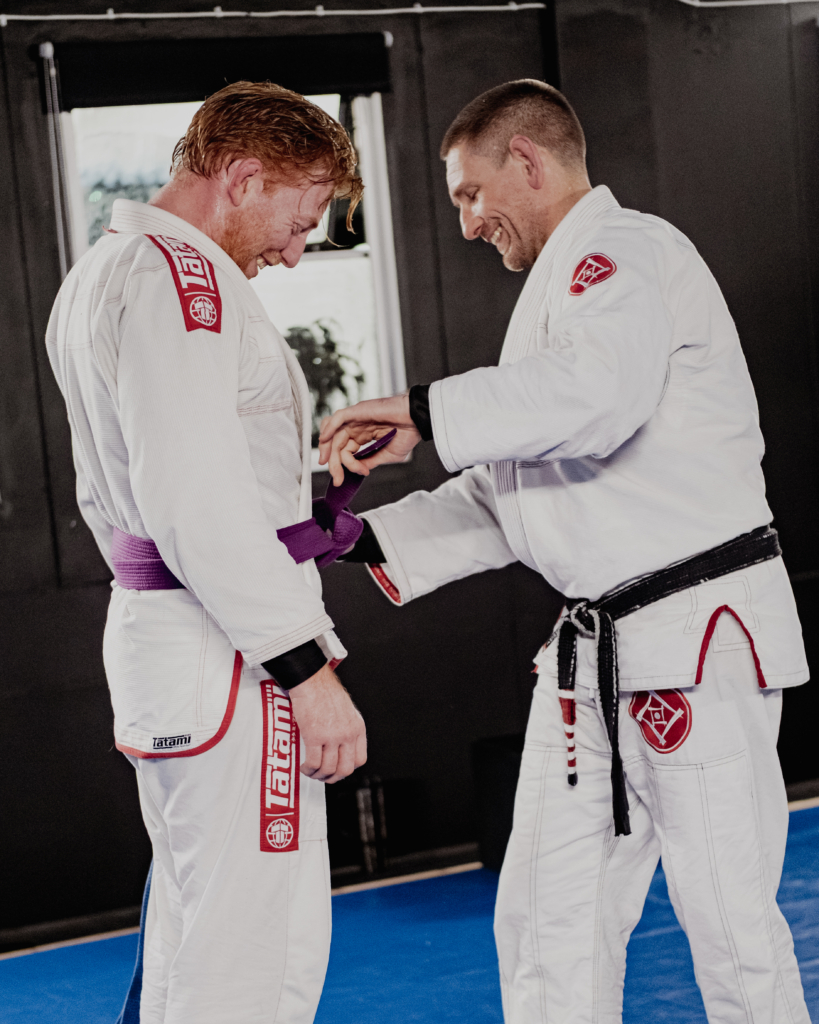
Purple belt is where Jiu Jitsu becomes yours. This is no longer about learning everything – it’s about organising what you already know.
Your operating system exists to turn knowledge into reliability.
Primary Focus
- System building
- Transitions
- Decision-making under resistance
Standards to Install
- “I know my first, second, and third option.”
- “I can explain why I choose this path.”
- “My Jiu Jitsu looks the same under pressure.”
What Success Looks Like
- A recognisable A-game
- Fewer panic decisions
- Cleaner transitions, even when things go wrong
Boundaries
- Chasing novelty over depth
- Relying on athleticism to cover gaps
- Avoiding uncomfortable weaknesses
Brown Belt OS: Refine Under Pressure
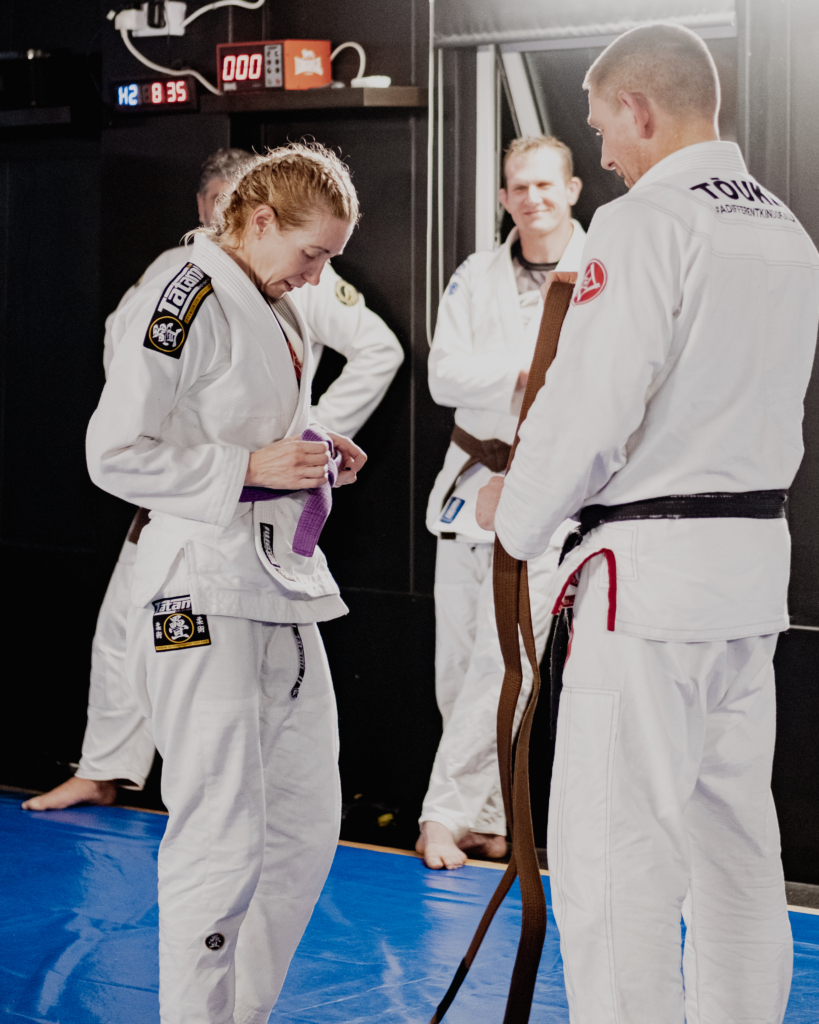
At brown belt, effort is no longer the limiting factor, efficiency is.
Your operating system exists to protect what you’ve built.
Primary Focus
- Precision
- Timing
- Energy management
Standards to Install
- “I win exchanges before they become scrambles.”
- “I solve problems with positioning, not force.”
- “My Jiu Jitsu conserves energy.”
What Success Looks Like
- Calm decision-making
- Smaller movements with greater effect
- Fewer unnecessary exchanges
Boundaries
- Proving toughness instead of intelligence
- Winning rounds at the cost of longevity
- Confusing effort with effectiveness
Black Belt OS: Model the Standard

At black belt, your Jiu Jitsu is no longer just yours. It teaches — whether you intend it to or not.
Your operating system becomes the academy’s operating system.
Primary Focus
- Leadership
- Clarity
- Cultural impact
Standards to Install
- “My behaviour sets the tone.”
- “I make others better through calm.”
- “I uphold the room, not just myself.”
What Success Looks Like
- Students mirror your composure
- Training quality improves around you
- Your Jiu Jitsu looks dependable, not flashy
Boundaries
- Letting ego re-enter through status
- Withholding knowledge to maintain rank
- Treating leadership as optional
The Thread That Runs Through Every Belt
At every stage, the goal is the same: Build Jiu Jitsu that holds up. This means, your Jiu Jitsu works on bad days, under fatigue, against resistance, and across years – not phases. Your motivation will fade, that’s inevitable. Your intensity will fluctuate, but a well-installed operating system keeps you moving forward even when nothing feels easy.
Check your operating system
Next, let’s stay on top of this – what gets measured, gets improved upon.
Click the below image to run your 3-minute self-diagnostic.