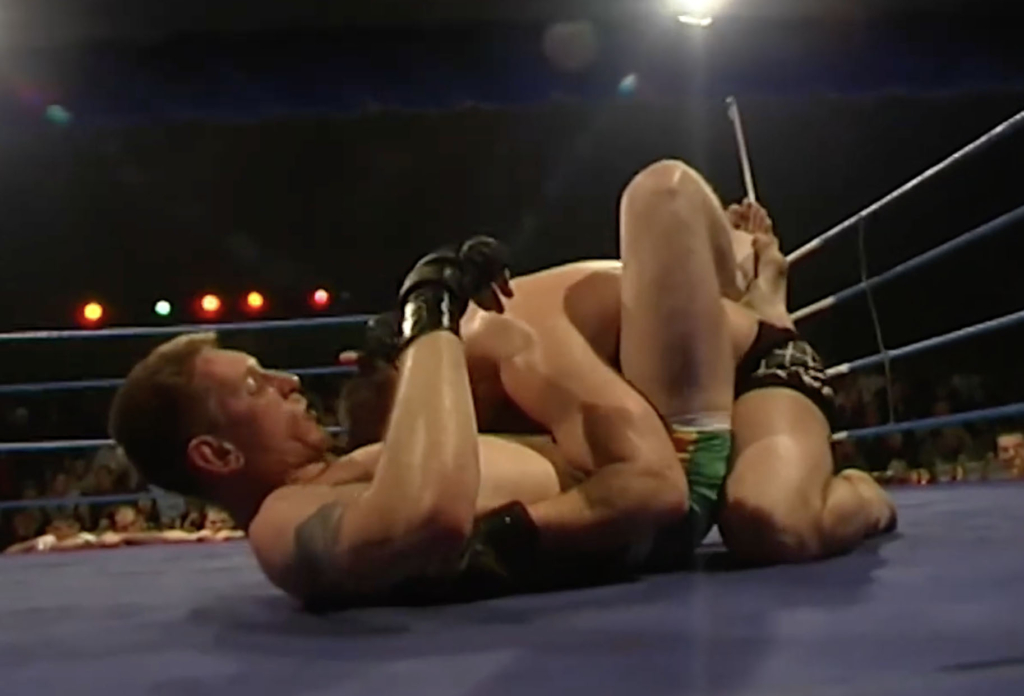
Back in the early 2000’s, like most of my generation of martial artists, I fought in the early days of the UK’s no-holds barred (NHB) scene. Events were set in nightclubs, leisure centres, or working men’s clubs, not too often and usually on mats with the audience within touching distance.
It was called NHB because we’d never heard of MMA, this was the days of VHS – before the Ultimate Fighter show on Spike TV.
During this time, the Fighter’s Notebook was the only real instructional. Vitamins and Minerals, Bad Boy and Hunter were ubiquitous, and Harbinger gloves, fitted better if you unpicked the stitching to remove the bar in the palm.
I fought my first bout in December 2001 at Pulse nightclub in Stevenage during the intermission of Trevor Spencer’s Muay Thai and Kickboxing event called Night of the Gladiators. It wasn’t in a cage, because we didn’t have cages then and most of the spectators didn’t watch because they’d come to watch Muay Thai, not two men rolling around on the floor in tight shorts.
I won that match and my next three, but something happened in my fourth bout that I vividly remember. I recall standing with my corner team about to walk out at the Aston Villa Leisure Centre, my walk out music had just begun – Blur the Technicolour by White Zombie – when I looked at my team and said: “I don’t wanna do this…”
“Bit late now, dude!” One of them said.
I lost that match by TKO.
I should’ve won, I was better than my opponent, but I gave up. I didn’t want to be in there anymore.
After winning three straight matches, I’d developed this nervousness, an anxiety about losing. I had this overwhelming fear of embarrassment. A fear of being seen trying, and a fear of being viewed as incompetent – being found out.
It was totally irrational.
I’m not sure where it came from or why it started. I’d competed as a kid in Karate competitions; had nerves there too but this was a different kind of nerves. It wasn’t about danger or the audience, truthfully, I’m not sure what it was.
I carried on with the MMA and eventually ended with a record of 4-5-0, but the last few bouts where horrendous for me, and, since that time, I’ve done a lot of soul searching, thinking and trying to comprehend how to overcome the issue.
You see, nerves shrink you, nerves stop you from being curious. You become self-centred (in a good way), mechanisms for self-preservation kick in and you start monitoring yourself. Competing in any form of individual endeavour is a lonely place – especially fighting. It’s not the weeks of training that are lonely, the time spent getting ready with your team; It’s the sitting around at home, the long runs, cutting weight, calorie counting, thinking about the day, and just getting in your own head.
You ruminate, a little too much, with yourself.
That’s the problem.
Pursue the craft
Over the years and through rationalising and maturing into my training, I’ve grasped that there’s a different way to think about competing, to stop the rumination. I am going to share my thoughts across a number of posts but let’s start here.
I’ll eventually get to identity, confidence, self-talk, embracing abundance, and dealing with mind-chatter; but for now, an easy place to start is to understand everything becomes easier to deal with once you have the 5 Rs in place: Readiness, Relationships, Routine, Rehearsal and Repetition. It’s a balancing act, all five work in combination and must be leant into if you want to put your best foot forward.
- Readiness: how you prepare for competition (strength and conditioning)
- Relationships: the people around you (husband, wife, training partners)
- Routine: the process you follow (daily, weekly, monthly)
- Rehearsal: mentally previewing the day and how you’ll respond (manifesting and visualising)
- Repetition: the practice you’ve put in (volume, mat time)
Each of the above is useless in isolation but one does have greater potential to take you further than the others in that respect.
Repetition – the practice you put in should be the first chapter you lay down if you are to overcome any over-thinking or aspect of rumination surrounding the task at hand.
It is through that work, the repetitions, that an element of confidence develops. You believe in your skill, and your underlying ability to carry through on a task. Mat time, volume, call it what you will; you have been here before and that experience, those layered mistakes grow into something.
Now, another way to frame this idea of repetition, which can become very mundane and exhausting at times, is for you to stop thinking about yourself, the failure, potential embarrassment and not meeting any expectations. Instead, begin thinking about the task of learning, the abundance that will come from that learning; think of the skills that will come from just doing the task for the sake of the craft.
That competition that you’ve been putting off, talking yourself out of; think of it, not as a competition [an anxiety filled event], but just another task – a task you can indulge to pursue the craft. Any result – win or lose, it’s all just data.
If you are true to yourself, and the curiosity attached to doing this thing that you’re pursuing, you’ll realise the event is all part of the craft. If you forget about the event [and your performance in it], remove your Self from it, you’ll see; you’ll understand that it’s all about betterment.

Do the reps
At the heart of all of this is the anxiety of self-exposure and the fear of what you’ll feel about yourself if the moment doesn’t go perfectly – an inward addiction, that loops back to self-monitoring.
What if I look bad? What if I lose and everyone sees? What if people see me lose and think less of me?
When you’re stuck on this inward loop there can be no outward trajectory, and it’s that trajectory that will enable you to compete and get batter at doing it.
Your principal thought should be centred on pursuing the craft – project outward and be genuine about it. Genuine about craft, curiosity, and clarity. The craft provides drive, enabling curiosity to deepen, and all of that resultant clarity will reignite desire to go again – do this and anxiety loses all its fuel.
The hard truth is that most ruminate over competing, about “testing” themselves and what the outcome will be if they fall short, rather than just putting the reps in. Reps mean you stop needing an allegory or parable about why you don’t compete because you’ve built character. Reps remind you not to fear situations because you’ve built total proof in your game, and reps stop any speculation about the athlete you are, could’ve been or once were.
Learn to attribute your intentions away from self-judgement to the work itself – it should always be reps over rumination.