Are you looking to compete but don’t really have any idea of how things work?
What about: “Okay guys, ‘King of the Hill’, first to score a point. Any questions?”
Have you kept your hand down when you really should have asked or thought to yourself “I really should have looked online to understand what that means”. If so, this one is for you.
Let’s look at the most basic of rules of Brazilian Jiu Jitsu, those associated with IBJJF based competitions and lay out the bare bones of what to expect and how to behave.
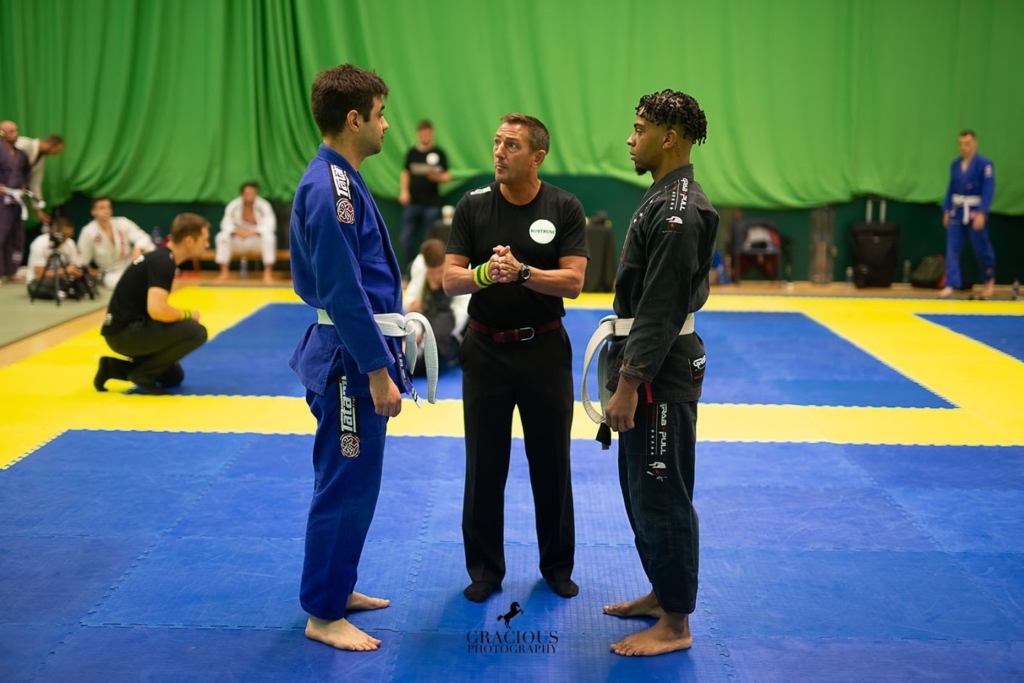
Simply, by entering a Jiu Jitsu event you must be invested in the outcome, so understanding the stage and structure of such an endeavour is paramount. When looking at the rules associated with Jiu Jitsu competitions, we are essentially discussing four areas:
- Etiquette
- The Scoring System
- Terminology
- The Do’s and Don’t’s
ETIQUETTE AND PROTOCOL
How you behave and conduct yourself within the competition setting is essential. Common sense certainly prevails in several areas here but in the main you should be looking at the following.
CLOTHING AND ATTIRE
Ensure all your competitive equipment – your Gi and Obi (belt) – are clean, tidy and in no way damaged or frayed. Having a Gi that you are used to wearing and that is comfortable is essential for performance however, official IBJJF (International Brazilian Jiu Jitsu Federation) events insist your Gi and belt are checked before competing for patch position, relative sizing and suitability for the match, also understand for many championships you are only permit to wear a white, royal blue or black coloured Gi – we suggest you check with individual organisers on their stance on this point, you can check the IBJJF website here.
Rash guards beneath the jacket are not permitted to be worn by male athletes and, whilst gum shields are allowed, groin protectors are also prohibited as they provide the perfect fulcrum for many submission to be applied.
PERSONAL CLEANLINESS AND HYGIENE
Training with or competing against an unkempt individual with a dirty, unwashed Gi is never pleasant, think of your opponent, so ensure both you and your clothing is kept clean.
Long hair must always be tied back, no jewelry is permitted on the competitive area and finger and toenails must be clean and cut short. Footwear must be always worn when away from the mats – especially in the toilets, and always ensure you never step onto the mats in outdoor footwear or whilst eating or drinking.
TIMING AND PUNCTUALITY
Running a Jiu Jitsu event is a stressful task, planning is crucial but inevitably, issues arise throughout the course of a day that need attending to, additions and omission are thus required, and amendments are often made on an ad hoc basis.
Every competition organiser strives to be consistently attentive to every need before, during and after an event, the punctuality and smoothness of any competition is the result of focused planning and exhaustive preparation, as a competitor, play your part.
Upon entry to all competitions, you are asked to enter a specific weight category, this is you first agreement – Jiu Jitsu competitions do not allow any margin or flexibility in this agreement. Understand the terms and deadlines for changing weight categories in advance, this will serve you well should you be off target in the build up to your competition.
As your competition approaches, organisers release the brackets and timings of the day – check them, double check them. Understand where you need to be when you need to be there and listen for announcements. It is not uncommon for competitors to be disqualified for not being on time, indeed it is very common for competitors to be disqualified for missing weight.
CONDUCT AND BEHAVIOUR
Passions and excitement tend to run high in any combat sport, especially among spectators, parents, and teammates, this is a good thing. However, it must never exceed a healthy level of competitiveness. Bad language and intimidation are not be tolerated, the barracking of officials or referees by competitors, coaches or parents is unacceptable – contain yourself and always respect the athletes.
THE SCORING SYSTEM
Much like Judo, systems of wrestling, Sambo and other grappling arts, Jiu Jitsu has a system of scoring very peculiar to the sport.
The current system has been refined over many generations and indeed changed dramatically since its inception at the first Jiu Jitsu World Championships in 1996. Your goal whilst competing is to submit your opponent using legal techniques within the rule-set prescribed by the competition. Should you fail in this endeavour, and throughout the match your referee will award points, advantages and or penalties for movements, successful techniques, positions, and infringements the competitor that has amassed the most points ultimately, wins the bout.
The ‘grading’ of points within the IBJJF rule-set was originally defined by the respective positions advantage in a perceived self-defence situation. The largest number of points thus given for positions that executed the most dominant control.
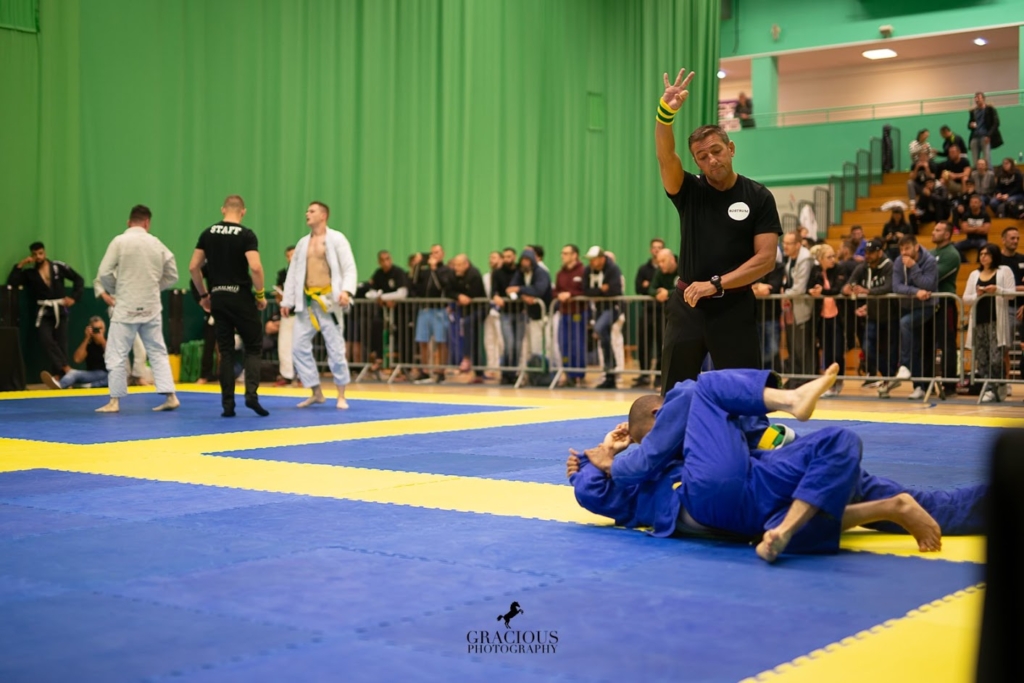
Criteria for scoring suggests, that successful techniques and positions must be held (under control) for a minimum of three seconds before points are awarded. Your referee will thus extend his or her arm to signify the awarding of points to the relevant competitor that are then recorded by the table official at your respective mat.
It is your responsibility to understand the etiquette, scoring system, terminology and do’s and don’ts before embarking on your first Jiu Jitsu competition, you can download the most up to date rules from the IBJJF website here for more practical advice and questions regarding the finer details, you should advise seek thorough guidance from your Jiu Jitsu coach.

SCORING POSITIONS
Below are the positions from within a match where a referee will award points to the athlete:
- Mount position: 4 points
- Back Mount position: 4 points
- Back Control: 4 points (hooks and seatbelt connected)
- Guard Pass: 3 points
- Knee on Belly position: 2 points
- Sweep from guard: 2 points
- Takedown or throw: 2 points
There is no target or winning number of accumulated points, rather each age level and belt ability will compete for a designated time and the competitor with the most points or advantages and least number of penalties after time has expired is considered the victor.
TERMINOLOGY AND LANGUAGE
Much in the same vein as Judo incorporates Japanese terminology into all Judo events, most Jiu Jitsu competitions are conducted in Portuguese. It is very important that you are aware of the three most basic phrases, terms, and their usage to avoid misunderstanding and any potential embarrassment.
STARTING A MATCH
Once competitors are called to the mat and after the brief introductions from your referee and their enquiry as to your ‘readiness’, he or she will indicate the start of the match with their hand open and in a downward ‘chopping‘ motion by saying the word ‘Combate‘ (meaning start or begin). This word and its accompanying signalling may be used anytime the referee restarts the action after it has ceased.
*Those with a background in Judo should recognise this indication as the equivalent to ‘Hajime‘ in Japanese.
STOPPING A MATCH
In wishing action to be paused or stopped – for infringements, to signify the end of a bout, for safety reason or to restart the match in the centre of the designated area – the referee will extend both hands laterally away from his or her chest and shout ‘Parou‘ (meaning stop), much in the same way ‘Matte‘ is called in Judo – you must stop immediately.
WARNINGS DURING A MATCH
At a very basic level, the only other time your referee will vocally indicate an instruction is when they call for movement or action (non-stalling). During a Jiu Jitsu contest there must be consistent and constant progression towards an outcome. Should your referee be under the impression that action has stalled he or she will indicate to the competitor to which the warning is to be issued, interlock their hands, and announce ‘Lute‘ (meaning fight) at which point, action must be pushed accordingly. If not, penalties may result to the stalling competitor.
ADVANTAGES AND PENALTIES
Submitting an opponent with equal skill level in Jiu Jitsu is difficult, indeed so is scoring points, so during a bout athletes may be rewarded for their efforts on movements and techniques that fell marginally short of their planned outcome, in this circumstance advantages are awarded. When the scores are tied at the end of a bout, the athlete with the most advantages is victorious – it is important to note that advantage scores do not accumulate and become points.
Paradoxical to this, for infractions on the rules, athletes are given penalties that also show on the scoreboard and can affect the outcome. Incurring penalties can result in an athlete getting disqualified, to see how advantages and penalties function in an event using the IBJJF ruleset click here.
THE DO’S AND DON’T’S
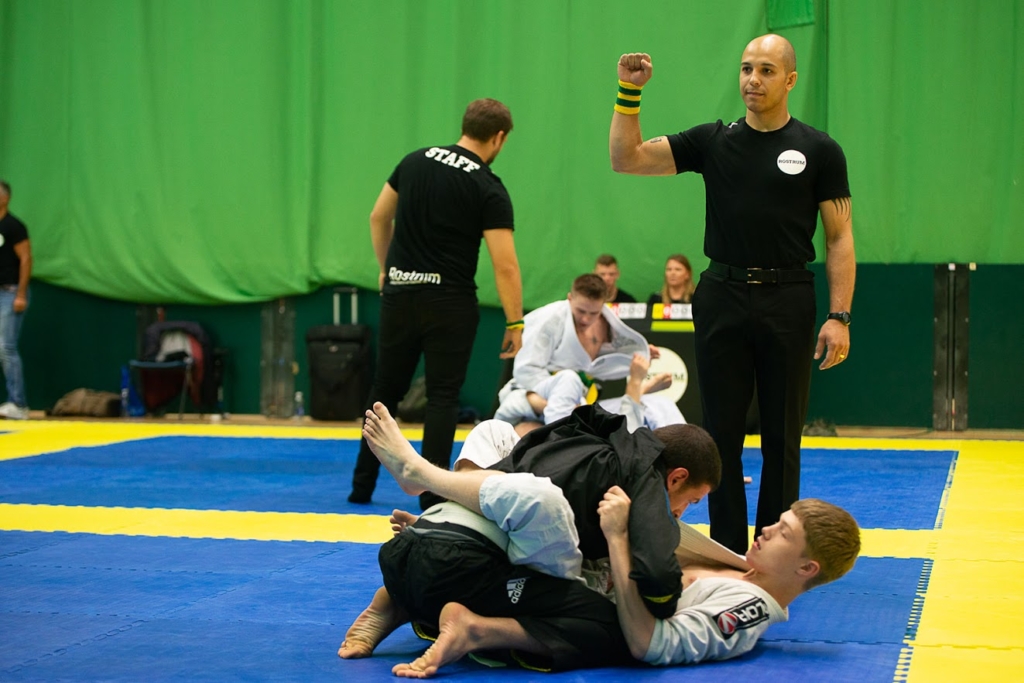
The health and safety of all competitors is paramount.
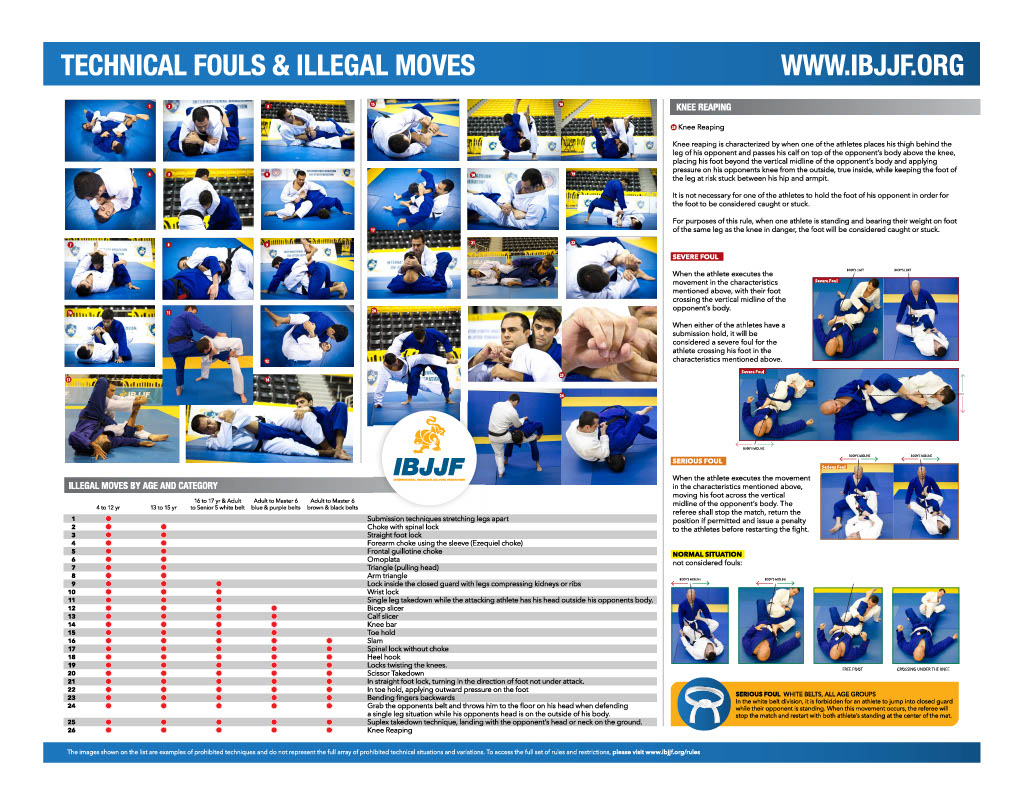
Whilst you are essentially battling against your opponent in a physical contest, this must be done within the confines of a rule set that has been designed to keep you both safe from harm. Regarding this, there are several prohibited movements included to maintain this safety and competitive level-headedness to our sport.
See the breakdown below where red dots signify illegal movements for the specific levels of competition:
Again, for an in-depth understanding, review of the techniques above and other issues I suggest you look to download the most up to date rules available from the IBJJF website here and for more practical advice speak with your coach.
WHAT NEXT?
Enter a competition!
Whilst competing is not for everyone that begins Jiu Jitsu, it is an invaluable tool that provides introspection like nothing else. I personally believe that an individual should compete at least once at every belt. It is a great opportunity to test your ability against someone of the same age, weight and ability but much more than this, it teaches you to cope with the anxieties associated with performing in front of other people.